History of milling in France
Milling is one of the oldest processing industries in human history. Before the industrial mill came the mill; before the mill, the hand-turned quern. In France that history is written into the landscape: watermills at the bottom of valleys, windmills on the ridges, and multi-storey flour mills beside railways and canals. Three generations of buildings, three ways of turning wheat into flour.
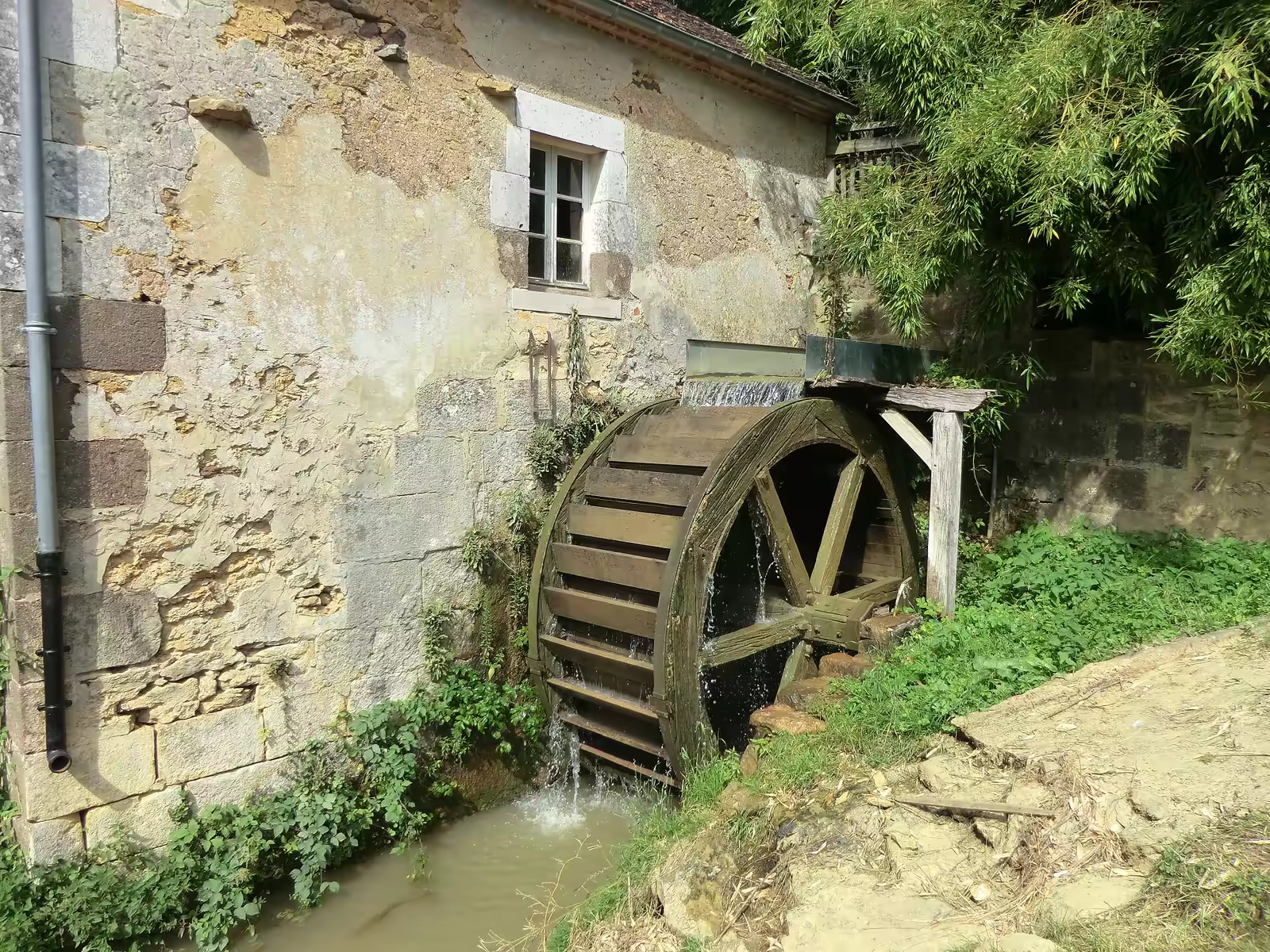
The millstone, from the Romans to the village miller
Rotary millstones appear in antiquity, driven by human or animal power. The watermill spread through Roman Gaul and then across medieval France, where it became a structuring piece of equipment: the seigneurial milling monopoly, the “banalité”, obliged peasants to grind their grain at the lord’s mill. The windmill arrived in Europe in the 12th century, from the Arab-Persian world, and conquered the flat regions where no watercourse was available.
Until the 19th century the technique barely changed. Grain was crushed between two stones: a fixed bedstone and a rotating runner stone above it. The gap between them set the fineness. The resulting flour was wholemeal, full of bran, and had to be bolted — sieved — to remove the coarsest particles. It was slow work, sensitive to the quality of the stone and the miller’s touch.
The 19th century: the roller replaces the stone
The break came with industrial milling. In the mid-19th century, cast-iron roller mills progressively replaced the millstones. The innovation, first developed in Hungary and Switzerland, spread quickly through France. The principle: fragment the grain through successive passages between fluted and then smooth rollers, separating the bran from the floury endosperm at every stage. White, fine, regular flour could then be produced in bulk.
The flour mill differs from the traditional mill in its vertical organisation. The machines are stacked over several floors: the wheat rises to the top of the building, descends from machine to machine by gravity, and emerges as flour on the ground floor. The plansifter, a mechanical sieve with stacked horizontal plans, replaces manual bolting. Where a mill produced a few sacks a day, a flour mill processes dozens of tonnes.
Concentration and its legacy
The late 19th and 20th centuries saw massive concentration. Flour mills settled near transport routes: the Paris basin, Alsace, the great grain ports such as Rouen and Marseille. Small village mills closed by the thousand, undercut by the factory and by the arrival of electricity, which made the artisanal mill economically untenable.
The current sector still bears the mark. According to the Association nationale de la meunerie française (ANMF), France today has about 380 to 400 mills, producing more than 4 million tonnes of flour a year from wheat that is almost entirely French (99% of supplies). French milling, second in Europe behind Germany, directly employs over 6,000 people. Flour exports, for their part, have collapsed: from 1.6 million tonnes in 1995 to about 214,000 tonnes in 2024.
What remains of the mills
The mills that stopped grinding did not all disappear. Many were converted into housing, public facilities or holiday cottages, when they were not restored by heritage associations. The Ministry of Culture’s Mérimée database records a significant share of this heritage, but hundreds of mills remain unprotected, at the mercy of abandonment.
It is this double inheritance — industrial and vernacular — that makes milling interesting today. It reads at once as a technical history (from stone to roller), a social history (from the seigneurial miller to the industrial miller) and a history of landscape, that of the valleys and the cereal-growing basins.
To go further
- From wheat to flour — the precise stages of milling.
- Flour types — T45, T55, T65, T80, T110, T150.
- Mills turned into gîtes — what becomes of the buildings.
- The Vendée, land of flour mills — over 2,000 mills in 1809.
Sources
Frequently asked questions
What is the difference between a mill and a minoterie?
A mill grinds grain with a stone millstone, on a small scale. The minoterie, which appeared in the 19th century, is an industrial roller-mill tool producing flour continuously and in large quantities.
When did industrial flour mills appear in France?
In the second half of the 19th century, with roller mills and steam power, which gradually replaced stone mills.
Why did most mills disappear?
Competition from large industrial mills, faster and better equipped, doomed most small mills around the turn of the 20th century.
What becomes of this heritage today?
Many mills and minoteries are restored, open to visitors, or converted into homes and gîtes.