From wheat to flour: the stages of milling
A modern mill does in a day what a stone mill did in a month. But the underlying principle has not changed: separate the floury endosperm of the grain from its outer shell, the bran, without mixing them. The difference is precision, and the breaking down of the work into dozens of successive operations. Here is the exact path of the wheat, from the intake pit to the flour.
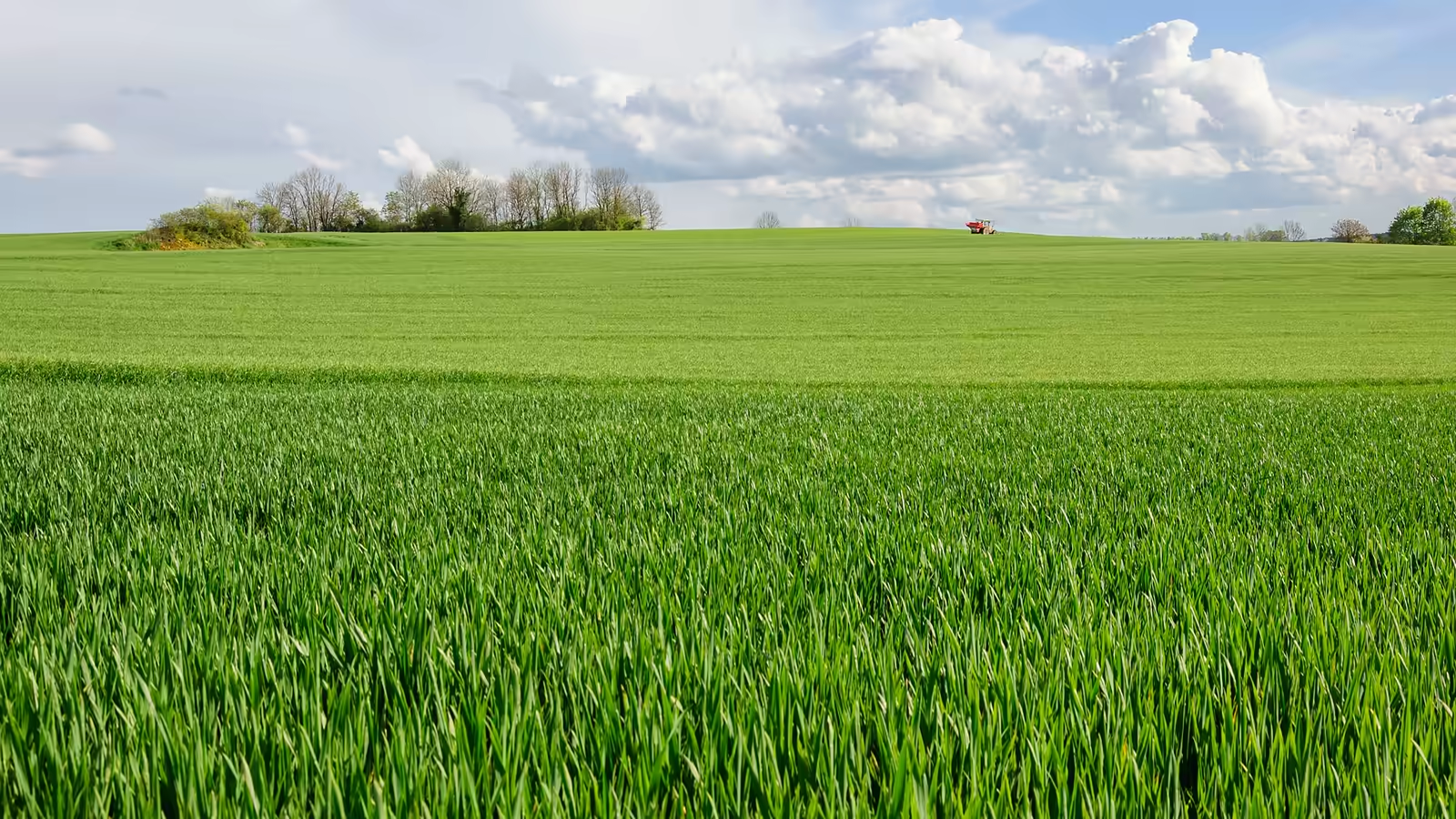
Photo: Myrabella — Wikimedia Commons, CC BY-SA 4.0.
1. Intake and inspection
Wheat arrives at the mill by lorry, in bulk. Before it is even unloaded it is checked: moisture content, specific weight, protein content, any broken grains or foreign bodies. These measurements determine how the batch will be handled and, above all, which other batches it will be blended with. The flour sold under a single brand is in fact a mix of several wheats, dosed to produce a consistent quality.
2. Cleaning
Wheat is never ground as it arrives. It passes through a cleaning line that removes straw, dust, stones, foreign seeds and diseased grains. In practice: a grid separator sorts by size, a destoner removes pebbles by density, and a brushing machine removes shrivelled or broken grains. At the end, the wheat is clean and graded.
3. Conditioning
A less well-known but decisive stage. The grain is lightly moistened — by a few tenths to a few percentage points depending on variety and season — then left to rest for a few hours. The aim is to soften the outer shell so it separates more easily from the endosperm, and to ease separation at the grinding stage. Poorly adjusted conditioning, and the bran tears into fragments impossible to separate from the flour.
4. Grinding: breaking, scalping, reduction
The heart of milling happens in three phases, through roller mills.
Breaking cracks the grain: fluted rollers turning at different speeds open the wheat and detach the coarse semolina. Scalping takes this semolina to separate out the remaining bran. Reduction, finally, using smooth rollers, reduces the fine semolina into flour proper.
Between each passage the product is sifted and graded. Nothing is wasted: what is not fine enough returns to an earlier stage. The wheat makes several dozen passages before the flour is finished.
5. Bolting and grading
Sorting happens in the plansifters, large mechanical sieves with stacked horizontal plans that classify particles by size. This is where the different flour streams are separated. A purifier completes the set: it sorts the semolina by density and purity, to remove the last traces of bran.
6. Flour type and final blending
At the end of milling, several flours are obtained, from the whitest to the most wholemeal, characterised by their ash content: this is the “type” (T45, T55, T65…), which measures the mineral matter left after combustion. The whiter the flour, the further extraction has been pushed — and the higher the extraction rate, meaning the quantity of flour obtained from 100 kg of wheat. A standard white flour corresponds to an extraction rate of around 75 to 80%.
The flour is then blended to the target recipe, enriched with fava bean flour or ascorbic acid in some cases, and stored in silos or bagged. The wheat’s journey to flour is over; the flour’s journey to bread begins.
To go further
- Flour types — T45, T55, T65, T80, T110, T150 and their uses.
- History of milling in France — from stone to roller.
- The Vendée, land of flour mills — over 2,000 mills in 1809.
- Mills turned into gîtes — what becomes of the buildings.
Sources
Frequently asked questions
How long does it take to turn wheat into flour?
A modern mill does in a day what a stone mill did in a month, by breaking the work down into dozens of successive operations.
What is the extraction rate?
It is the quantity of flour obtained from 100 kg of wheat. A standard white flour corresponds to an extraction rate of around 75 to 80%.
Why is the wheat moistened before grinding?
Conditioning softens the grain's outer shell so it separates more easily from the floury endosperm at grinding.