Flour types: T45, T55, T65, T80, T110, T150
The “type” of a French flour, the figure preceded by a T on the label, refers to one thing only: its ash content. A sample of flour is burned at high temperature, and the mineral residue that remains is weighed. That weight, expressed as a percentage, gives the type: a T55 leaves 0.55% ash, a T150 leaves 1.50%. The higher the number, the more of the grain’s outer shell the flour has kept — and the further its taste, colour and fibre content move away from white flour.
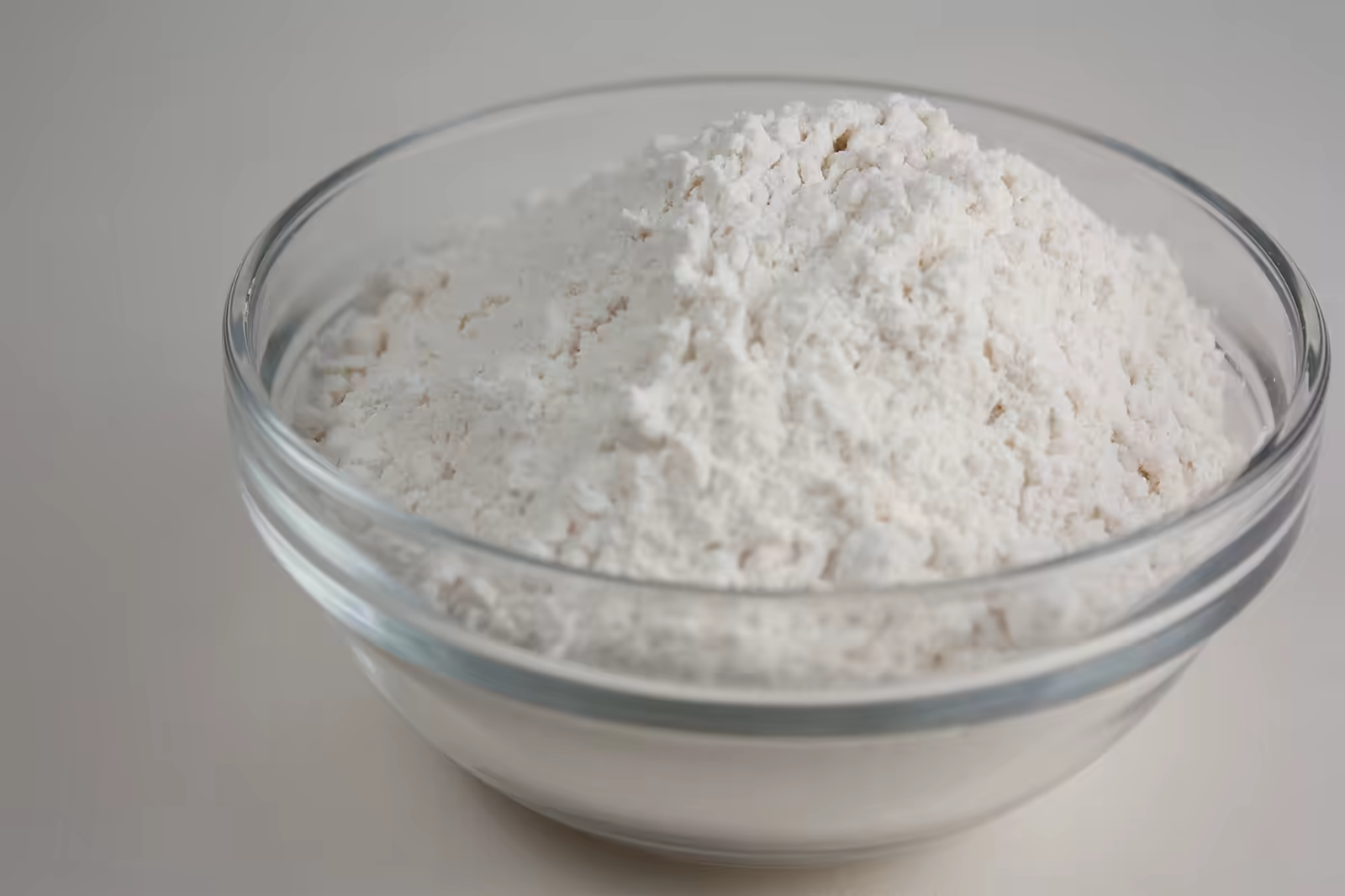
Photo: Veganbaking.net — Wikimedia Commons, CC BY-SA 2.0.
The six common types
T45 (0.45% ash) — the whitest and finest flour. It contains very little bran and suits fine pastry, viennoiserie and crêpes, where lightness and a very white crumb are wanted.
T55 (0.55%) — the reference bread flour, that of the baguette and everyday white bread. Balanced, it rises well and gives an even crumb.
T65 (0.65%) — the “tradition” flour, slightly higher in bran. This is the flour of French tradition loaves, country breads and pizza dough, for a slightly more pronounced taste than T55.
T80 (0.80%) — the “bise” or semi-wholemeal flour, found in semi-wholemeal breads and organic baking. The taste of the wheat begins to come through.
T110 (1.10%) — the standard wholemeal flour, used for wholemeal bread. Rich in fibre, it gives a denser crumb and a clearly stronger taste.
T150 (1.50%) — whole-grain flour, keeping almost the entire grain, bran included. It is the richest in fibre and minerals, the most characterful, and the hardest to work in pure breadmaking.
Type, extraction and bran
The type does not tell the whole story. It must be read alongside the extraction rate: the quantity of flour obtained from 100 kg of wheat. A very white flour (T45, T55) corresponds to a high but partial extraction — a large part of the grain, the bran and germ, has been removed to keep only the endosperm. A whole-grain flour (T150) corresponds to an extraction close to 100%: almost the whole grain is in the flour.
That is why the type is an indicator of nutritional richness as much as of taste. The bran holds most of the wheat’s fibre, minerals and vitamins. A T150 is objectively richer than a T45. It is not a hierarchy of quality, but a scale of completeness: what you make determines what you choose.
What the type does not tell you
Two T55 flours can behave very differently depending on the wheat variety used, its protein content, and the strength of the flour (the W value, measured on an alveograph, which reflects its capacity to form a gluten network). The type describes composition, not strength. That is why professional bakers reason by combining the two: the type for taste and colour, the W for dough strength.
In short: the T is a partial but reliable identity card. It says where the flour sits on the scale of refinement. For everything else — terroir taste, baking strength, oven behaviour — you have to look further.
To go further
- From wheat to flour — the precise stages of milling.
- History of milling in France — from stone to roller.
- The Vendée, land of flour mills — over 2,000 mills in 1809.
- Mills turned into gîtes — what becomes of the buildings.
Sources
Frequently asked questions
Which flour should I use for bread?
T55 is the reference bread flour (baguette, white bread). T65, slightly more characterful, suits tradition and country breads.
What is the difference between T45 and T150 flour?
T45 is the whitest and most refined, ideal for pastry. T150 is whole-grain: it keeps almost the entire grain, bran included.
What does the T in T55 stand for?
The T stands for ash content: a T55 leaves 0.55% mineral residue after a flour sample is burned.